On 18-19th March 2026, a series of events were held at UNESCO, Paris, to mark the end of the 'International Year of Glacier Preservation' and the launch of the 'Decade of Action for Cryospheric Sciences (2025–2034)'.
During the High-Level Opening Plenary, H.E. Ms. YANG Xinyu, Ambassador of Permanent Delegate of the People's Republic of China to UNESCO, highlighted the contributions Chinese researchers have made to cryospheric science, including through initiatives such as TPE and STEP. Ms. YANG affirmed that these contributions would continue, and that China is committed to increasing investment in cryosphere preservation and international cooperation.
Part of these contributions come in the form of a new scientific program coordinated by TPE. This program—Third Pole Glacier melt and Earth system consequences (TPGE)—was introduced at a side event on the 19th March. As Prof. YAO Tandong outlined, TPGE has 4 key tasks: 1) High-elevation glacier and climate changes; 2) Glacial disasters and early warning; 3) Melt-mediated Earth System interactions and teleconnections; and 4) TPGE legacy, encompassing plans for education and outreach. Thus, TPGE precisely aligns with and robustly responds to the Decade of Action for Cryospheric Sciences, while also marking a substantive step forward in interdisciplinary international cooperation focused on the Asian Water Tower and high-mountain cryosphere regions.
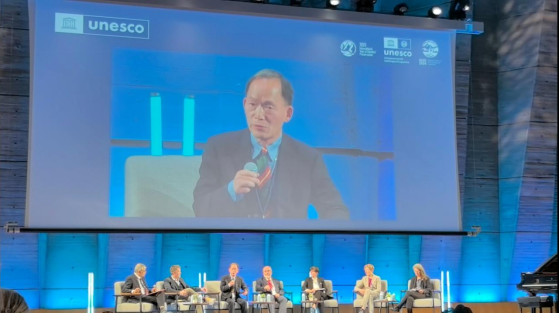
Prof. YAO Tandong sharing his insights in cryospheric research and preservation in the Third Pole
The side event—encompassing keynote speeches and a roundtable discussion—featured internationally renowned scholars including Prof. Michael Zemp (University of Zurich), Prof. Tobias Bolch (Graz University of Technology), Dr. Miriam Jackson (Norwegian Water Resources and Energy Directorate), Prof. Valérie Masson-Delmotte (Laboratoire des Sciences du Climat et de l'Environnement), Dr. Sonu Khanal (Hydrominds), Prof. GAO Jing (ITPCAS) and Prof. WANG Tao (ITPCAS).
A common theme amongst many panelists was that of data. As Sonu Khanal noted: "We need more data, there's no way around it. TPGE can really help in producing a harmonized data base for High Mountain Asia, bringing different technologies together to be a global, scientific leader". Valérie Masson-Delmotte built on that message, commenting "A legacy of TPGE could be the design of a policy relevant, optimized and sustained observing system...not for a few years, but for decades". Michael Zemp made more targeted recommendations, calling on TPGE to "extend in-situ monitoring with smart stakes that permanently measure ablation and accumulation" and to "find ways to get access to private or defense remote sensing data, as done with declassified spy missions, to extend time series".
Central to the success of TPGE is communication with all stakeholders. Miriam Jackson outlined the need to "involve local communities and policymakers more. Take them in the field and on glaciers. Show them what we're talking about; seeing glacier loss or the impacts of a GLOF is much more impactful that looking at figures on a screen". Valérie Masson-Delmotte echoed this point, emphasizing the value of climate-cryosphere literacy and the many ways in which that can be achieved: "Training teachers allows knowledge to be brought to the classroom and into the curriculum, producing a glacier-aware generation that is empowered to act… In the Third Pole you are working with the beauty of extraordinary landscapes and scientific field work, both offering unique opportunities to feed into popular culture and reach a very broad audience".
One final theme that emerged was that of trust. Several panelists commented on years or decades of friendship with YAO Tandong and other TPE scientists, providing a solid foundation for great science. Tobias Bolch commented "…building trust, friendship and understanding, while acknowledging and respecting any cultural differences and political limitations on both sides, really makes for fruitful collaborations and success". We hope these friendships will continue to thrive and that new friendships will form over the coming decade as part of TPGE and the Decade of Action for Cryospheric Sciences.
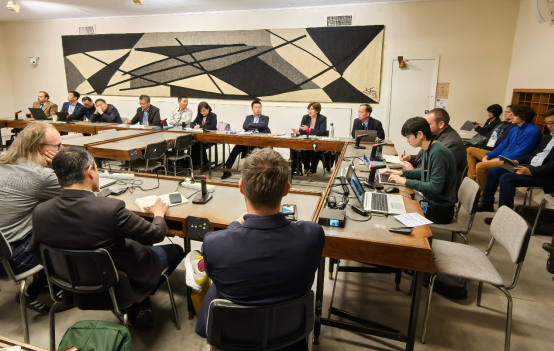
Prof. Valérie Masson-Delmotte on leveraging TPGE to drive meaningful global collective action and policy responses