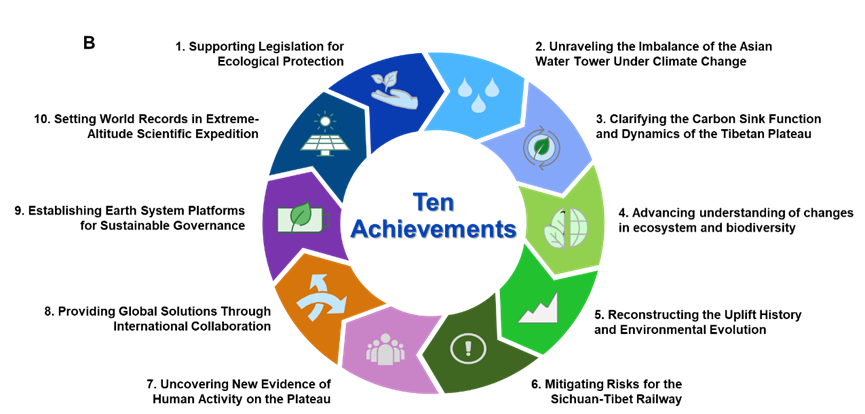
STEP launched in August 2017 to reveal the mechanisms of, and provide solutions to, environmental change on the Qinghai-Tibet Plateau, safeguarding the region as an ecological security buffer zone. 8 years later, that aim has been realized following the hard work of 7000 scientists from 222 institutes and 3000 field campaigns. These integrated achievements, reflecting STEP’s 10 key tasks, include:
- Providing comprehensive scientific support for the entire process of ecological protection legislation on the Tibetan Plateau.
- Establishing an integrated Earth system observation and early warning platform.
- Proposing an optimization plan for the construction of a national park cluster and a system of protected natural areas on the Tibetan Plateau.
- Assessing the positive effectiveness of major ecological projects on the Tibetan Plateau.
- Analyzing disaster risks along the Sichuan-Tibet Railway route.
- Innovating disaster prevention and control technologies for permafrost regions.
- Evaluating ice-water-sediment disaster risks in the Yarlung Tsangpo River basin.
- Achieving new breakthroughs in mineral resource exploration, such as lithium, potassium, and oil & gas.
- Establishing a scientific expedition monitoring network for greenhouse gases on the Tibetan Plateau and the "Gongga" system.
- Proposing a new development model for strengthening, consolidating, and revitalizing border areas.
As pointed out by Wang Junzheng, Secretary of the Tibet Autonomous Regional Committee of the Communist Party of China, STEP has supported Tibet’s ecological construction, green sustainable development, and disaster prevention and mitigation. Thus, collectively, these achievements contribute to regional sustainability of the Third Pole region.
For additional information, see STEP coverage and other media reporting of the event (CCTVnew, CASNews and CCTVvideo).